
Care homes and schools have two problems that gas boilers can't solve. They need to cut carbon, and they need to stay comfortable as summers get hotter. A chiller and fan coil system tackles both with one plant, and it is one of the strongest options for replacing an ageing gas boiler plant room.
This is the first in a monthly series on chillers and fan coil units for care homes and schools. We work from Barnet, North London, across London and the Home Counties.
What is a chiller and fan coil system?
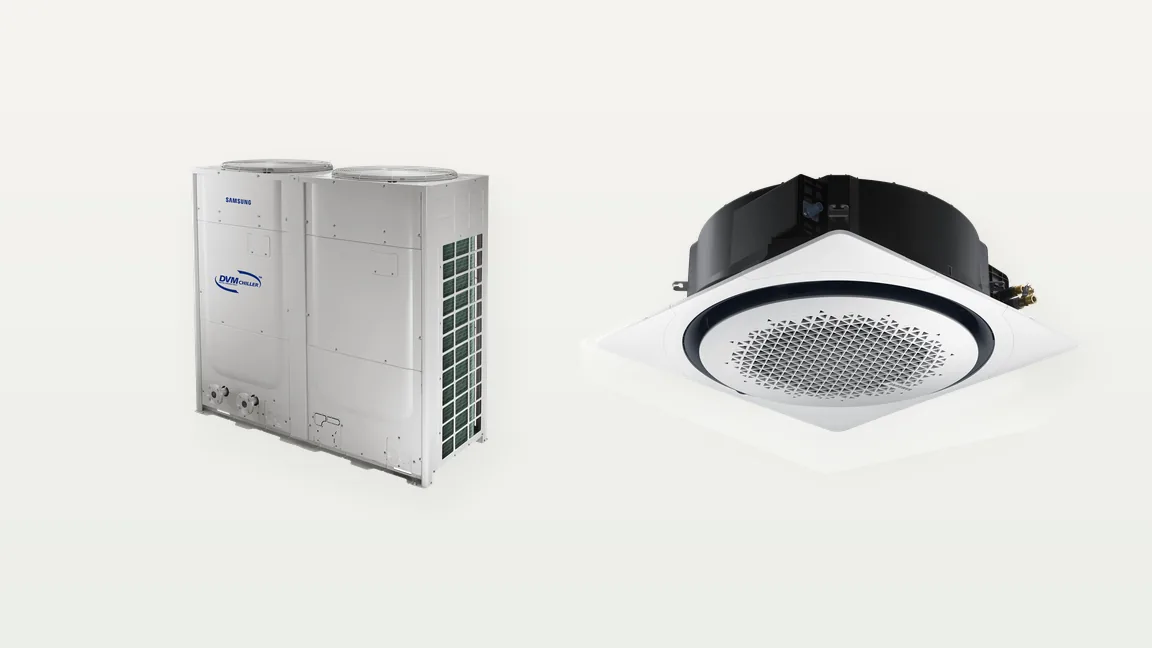
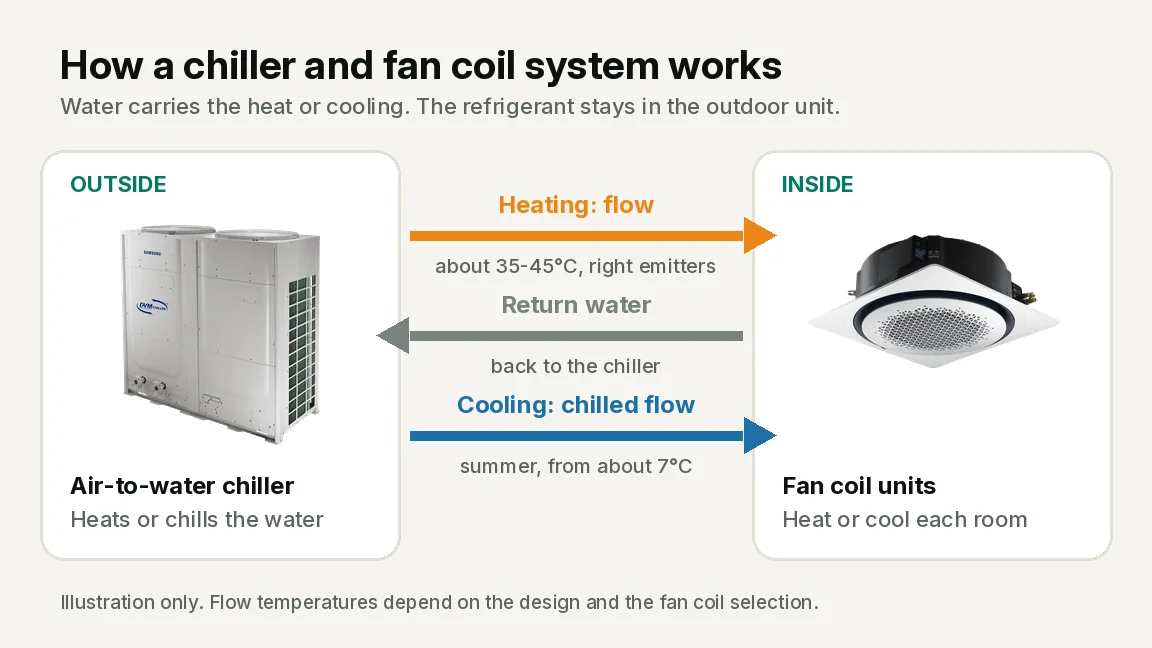
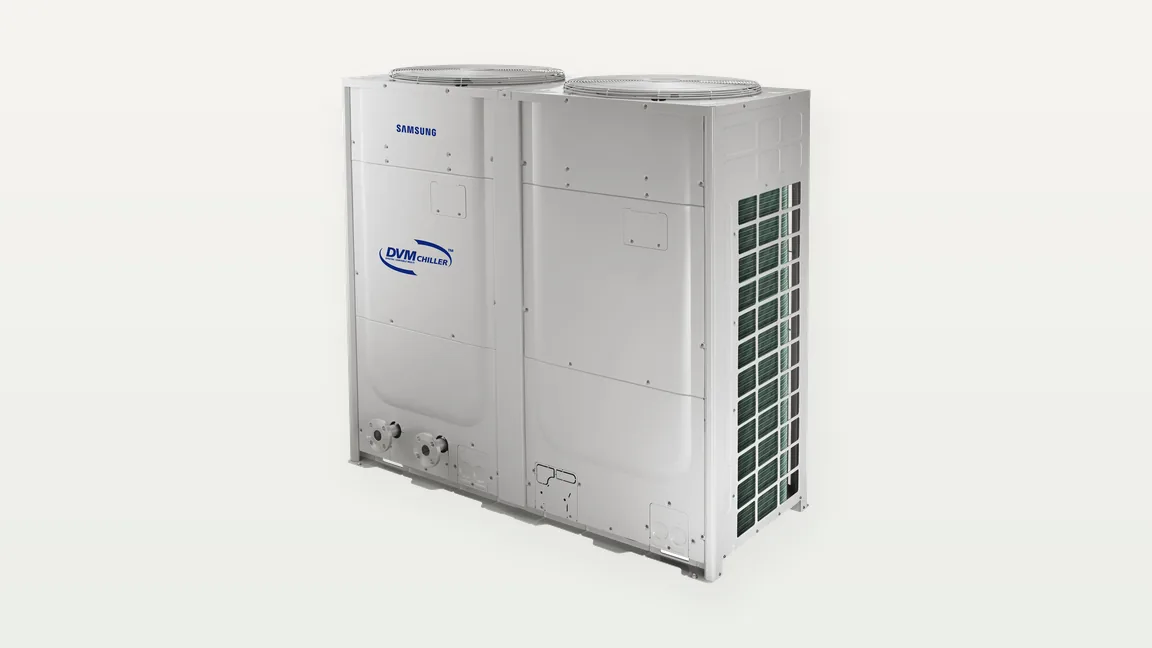
A chiller, in this sense, is an air-to-water heat pump. It sits outside, takes heat from the air in winter and puts it into water. In summer it can run the other way and chill the water. Pipes carry that water to fan coil units, which are room units, often in the ceiling, that blow air across a water coil to heat or cool the room.
Samsung's HVM chiller range is a good example. It is water-based, so there is no need for refrigerant pipework inside the building. The DVM S R32 models are rated at 42 kW and 56 kW, and Samsung says up to 16 outdoor units can be combined, so a plant can grow with the building.
1. Carbon comes first
A gas boiler burns fossil gas on site. A heat pump moves heat that is already in the air, using electricity to do it, and a well-designed system delivers several units of heat for each unit of electricity. As the grid gets cleaner, the carbon in that heat falls with it. For a care home or school with a net zero target, this is the main reason to move. Samsung's R32 chillers also use a refrigerant with a global warming potential of 675, which Samsung says is lower than R410A. For the basics, see our guide to heat pumps versus gas boilers.
2. Low flow temperatures, around 35°C, with the right emitters
Heat pumps are most efficient when the water they make is not too hot. Fan coils suit this because they push air across a large coil, so they can give useful heat from water at around 35 to 45°C, well below the 70°C or more that old radiator systems often ran on.
There is one condition: the units must be selected for the water temperature you design for. Samsung publishes its fan coil heating outputs at 45°C in and 40°C out, so at about 35°C the output is lower and a designer may need larger or more units. Samsung's chillers can make heating water from 25 to 60°C, which leaves room to serve new and existing emitters. A room-by-room heat loss calculation settles it.
3. Cooling when summers get hotter
UK Health Security Agency guidance asks care homes to provide a room or area that stays at or below 26°C, and to have a hot weather plan ready before 1 June each year. Older people, young children and people with breathing or heart conditions are at higher risk in hot weather.
A reversible chiller can chill the water as well as heat it, so the fan coils that heat in winter can cool in summer. Samsung rates its cassette fan coils for cooling with water at 7°C in and 12°C out. Good shading, ventilation and controls should always come first, with cooling added where it is needed.
4. Humidity control in summer
When a fan coil cools a room, moisture in the air condenses on the cold coil and drains away. That is why these units have a condensate drain, and Samsung's 360 cassette has a built-in drain pump that can lift condensate 750 mm. Cooling with fan coils therefore removes some moisture, which can make a muggy room more comfortable. Fan coils do not add humidity, and the effect depends on the design and the weather.
5. Lower surface temperatures for residents
The Health and Safety Executive says contact with surfaces above 43°C can cause serious injury, particularly for older people, children and anyone who cannot move away quickly. Its guidance for health and social care lists lower flow temperatures and low surface temperature emitters among the ways to reduce the risk, alongside covers and guards.
A fan coil system runs on much lower water temperatures than a traditional high-temperature radiator system, so accessible surfaces can run much cooler. That can reduce the need for radiator covers. It does not remove the need for a risk assessment: the maximum surface temperature at full output, including exposed pipework, still has to be checked in each space.
6. Filtered air, with realistic expectations
Every fan coil has a filter. Samsung's 360 cassette comes with a microfibrous filter, and an optional PM1.0 air purification panel is available. As room air recirculates through the unit, the filter can catch dust, which can help where windows are often shut and matters for residents and pupils with asthma. It is not a medical device or a substitute for fresh air: filters need regular cleaning and rooms still need ventilation. Asthma + Lung UK has practical advice on airing rooms and reducing dust.
Which fan coils suit which spaces?
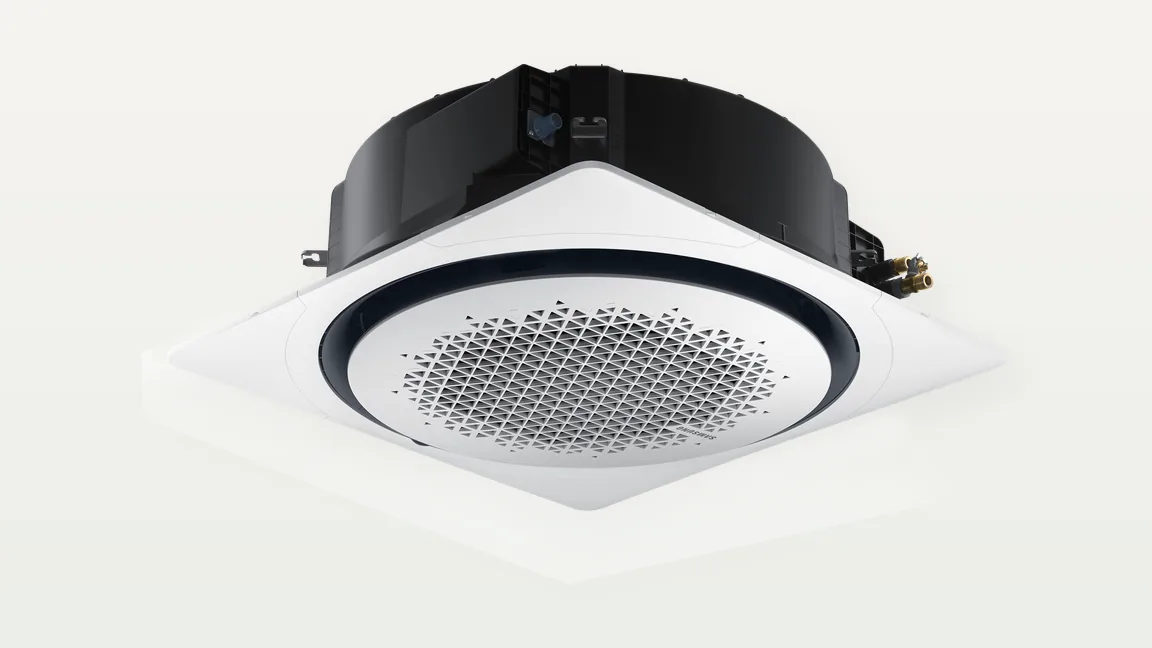
Samsung's 360 cassette range (AG060, AG072, AG090 and AG105MN4PKH) gives 6 to 10 kW of cooling and 7.3 to 10.7 kW of heating per unit, at sound pressure levels of 32 to 45 dB(A) measured in an anechoic room. The smallest model is 281 mm deep in the ceiling void. These suit classrooms, dining rooms and larger lounges. Smaller units for bedrooms and offices follow in later articles.
What to check first
- Heat loss, room by room. Fan coil sizes depend on it.
- Existing pipework and emitters. Some can be reused, some will not suit low temperatures.
- Plant space, noise and electrical capacity. The outdoor unit needs airflow and a sensible position.
- Controls and maintenance. Staff need simple controls and filters that are easy to reach.
Frequently asked questions
Can a chiller and fan coil system replace a gas boiler in a care home?
Often, yes. An air-to-water chiller can supply heated water to fan coil units in each room, so gas boilers are no longer needed for space heating. A survey confirms the loads, pipework and electrical capacity.
Can fan coil units really heat at 35°C?
They can work at low flow temperatures when selected for them. Outputs are often published at 45°C, so at 35°C more or larger units may be needed. The design decides this.
Will it cool the building in summer?
A reversible chiller can supply chilled water to the same fan coils, which can help keep key rooms comfortable in hot weather alongside shading and ventilation.
Do we still need radiator covers?
Not always. Lower water temperatures can mean lower surface temperatures, but the HSE expects a risk assessment, and exposed pipework still needs checking.
Talk to Heatmaster London
If you manage a care home or school and are planning to replace a gas boiler plant room, contact us or call 0330 133 1626. We will survey the site, check the heat loads and talk you through the options. You can also read about our commercial heating and cooling work.
Sources
- Samsung Climate Solutions UK, HVM chiller solutions
- Samsung Climate Solutions UK, HVM R32 chiller (42 and 56 kW, R32 GWP 675, heating water 25 to 60°C)
- Samsung, FCU technical data book (360 cassette outputs, rating conditions, sound levels, drain pump, microfibrous filter)
- Samsung Climate Solutions UK, 360 cassette FCU (optional PM1.0 filter panel)
- HSE, Managing the risk from hot water and surfaces in health and social care (HSIS6)
- UK Health Security Agency, Supporting vulnerable people before and during hot weather: healthcare professionals
- Asthma + Lung UK, Improving indoor air quality